
How to correctly read markings on hydraulic hoses?
At first glance, the marking on a hydraulic hose may seem like a complicated sequence of numbers, letters, and symbols. In reality, however, it is its “safety datasheet” – a set of key technical parameters that determine the correct selection, operating safety, and service life of the entire system.
Anatomy of the layline – a case study.
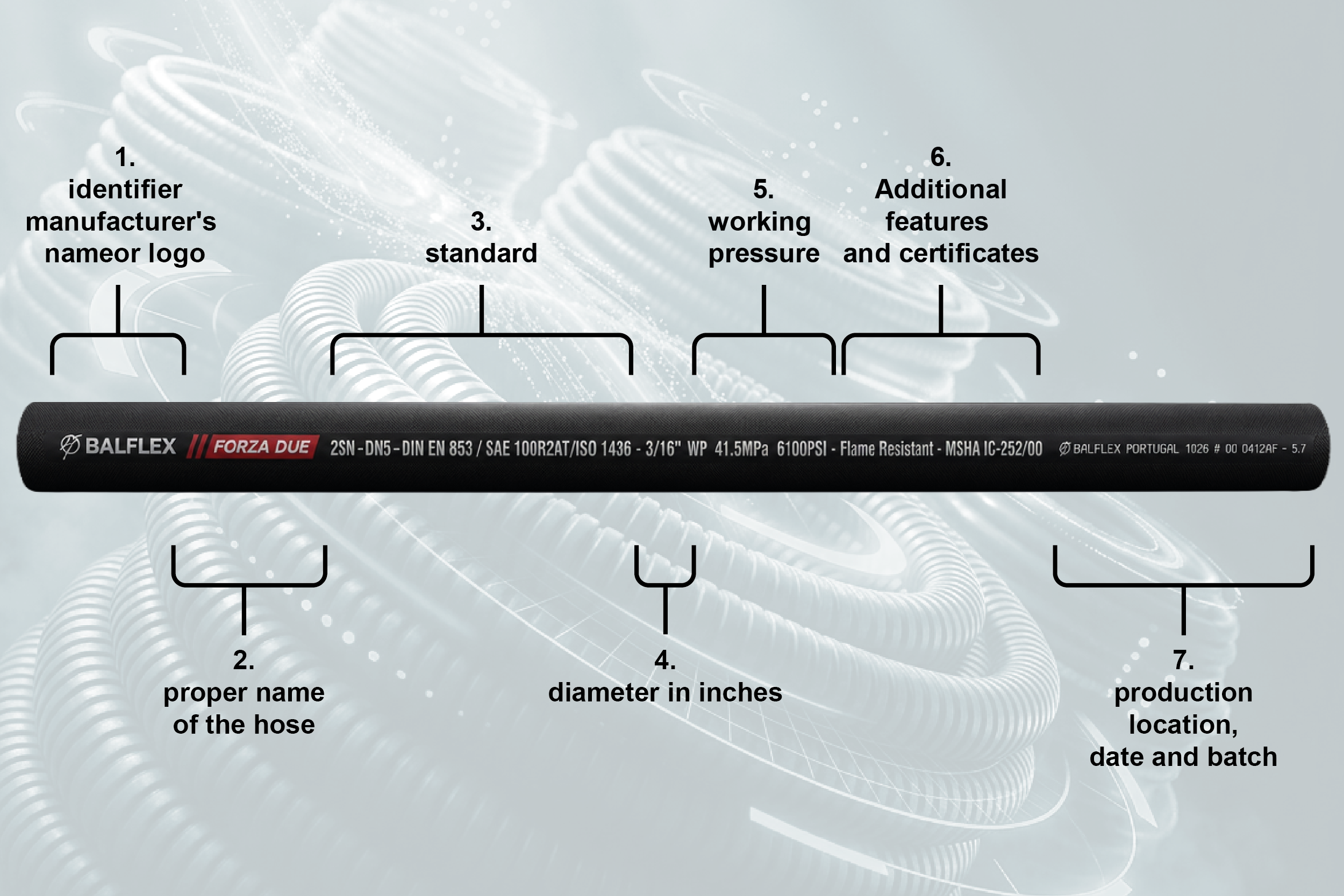
Layline segments – what do they mean in practice?
- Manufacturer identification – manufacturer name or logo.
- FORZA DUE – proprietary series name.
- 2SN – DN5 – DIN EN853….. – construction standard and type, European standard specifying a hose with two steel wire braids.
- 3/16″ – nominal diameter (inches), which means that the internal diameter of the hose is approx. 12 mm.
- WP 41.5 MPa / 6100 psi – working pressure (Working Pressure), maximum pressure for safe, continuous operation.
- Flame Resistant….. – additional features and certificates.
- Date, place and batch of production.
Standards and specifications are the foundation of quality and safety assurance for hydraulic and pneumatic hoses. Thanks to them, manufacturers guarantee that each product meets specific technical and performance requirements. The key aspects of this issue are:
- International standardization: Standards such as ISO (international quality standard), SAE (standard specifying pressure resistance), EN (European standards), DIN (German standards) or MSHA (Mine Safety and Health Administration), define precise technical parameters, pressure resistance, and environmental conditions, enabling global product comparison.
- Safety of use: Applying standards ensures that hoses operate safely in various applications, protecting against failures and hazards resulting from improper use.
- Trust and certification: Products meeting international standards often hold certificates confirming their high quality and compliance with rigorous industrial requirements.
The most important European standards for hydraulic hoses are:
EN 853 – 1SN and 2SN types
The EN 853 standard covers classic hydraulic hoses with one (1SN) or two (2SN) steel braids. They perform well in medium- and high-pressure installations — in agricultural, construction, and industrial machinery. The standard specifies the hose construction (oil-resistant rubber core, braid layer, outer cover resistant to abrasion and weather conditions), as well as minimum bend radii and permissible working pressures — hence the high reliability and repeatability of parameters.
EN 857 – 1SC and 2SC types
EN 857 is the standard for compact hoses — with a smaller outer diameter and greater flexibility than SN hoses. 1SC and 2SC are counterparts to the single- and double-braided versions, but in a compact form, suitable where installation space is limited. The standard defines hose construction, strength, oil resistance, and impulse requirements. Smaller bend radii perform well in machines with a large number of moving elements.
EN 856 – 4SP and 4SH types
EN 856 specifies four-spiral hoses with very high strength for extreme pressures. 4SP is a four-spiral hose for heavy loads, while 4SH goes a step further — featuring even higher pressures and greater impulse resistance. Construction: oil-resistant rubber core plus four layers of spiral steel braids, providing rigidity and resistance to pressure pulsation. These hoses are essential in high-pressure hydraulics — mining machinery, hydraulic presses, and heavy construction equipment.
EN 854 – 1TE, 2TE and 3TE types
EN 854 describes low-pressure hoses for return lines, oil installations, lubrication systems, and auxiliary applications. The reinforcement consists of a textile braid — hence high flexibility and chemical resistance at lower working pressures. Three variants: 1TE (single braid), 2TE (double), and 3TE (triple reinforcement for more demanding applications). They perform well where oil resistance and flexibility matter, rather than high pressure.
SAE 100R – a wide range of hoses
American standard covering several hose classes:
- SAE 100R1 and 100R2 — counterparts of single- and double-braided hoses,
- SAE 100R4 — suction and delivery hoses for low pressure,
- SAE 100R7 and 100R8 — thermoplastic hoses for high pressures and applications requiring chemical resistance,
- SAE 100R12, 100R13 and SAE 100R15 — multi-layer hoses for extreme applications, with parameters close to EN 856.
The standard describes materials, number of reinforcement layers, working pressures, temperature ranges, and bend radii. Due to the global scope of SAE, hoses complying with this classification are often treated as counterparts to European SN, SC, and spiral hoses.
Some hoses are directional (one-way), meaning the medium can flow in a specific direction. In such cases, there may be an arrow on the hose surface indicating the correct flow direction.


